My Casio F91W isn't just a watch; it's an act of defiance. In a world relentlessly pushing smartwatches that want to track your sleep, read your emails, and vibrate with the crushing anxiety of a thousand daily notifications, the F91W just says "no." It's a feather-light, unpretentious slab of 1980s technology that tells the time, has a backlight so perfectly dim you can check it at 3 AM without searing your retinas, and is water-resistant enough that you never have to take it off for a shower or a swim at the beach. It also possesses a stopwatch that I proudly used to time a 10k race last year. 52 minutes flat - no rollover required. My friend Justin saw me check it at the finish line and just shook his head, utterly bewildered.
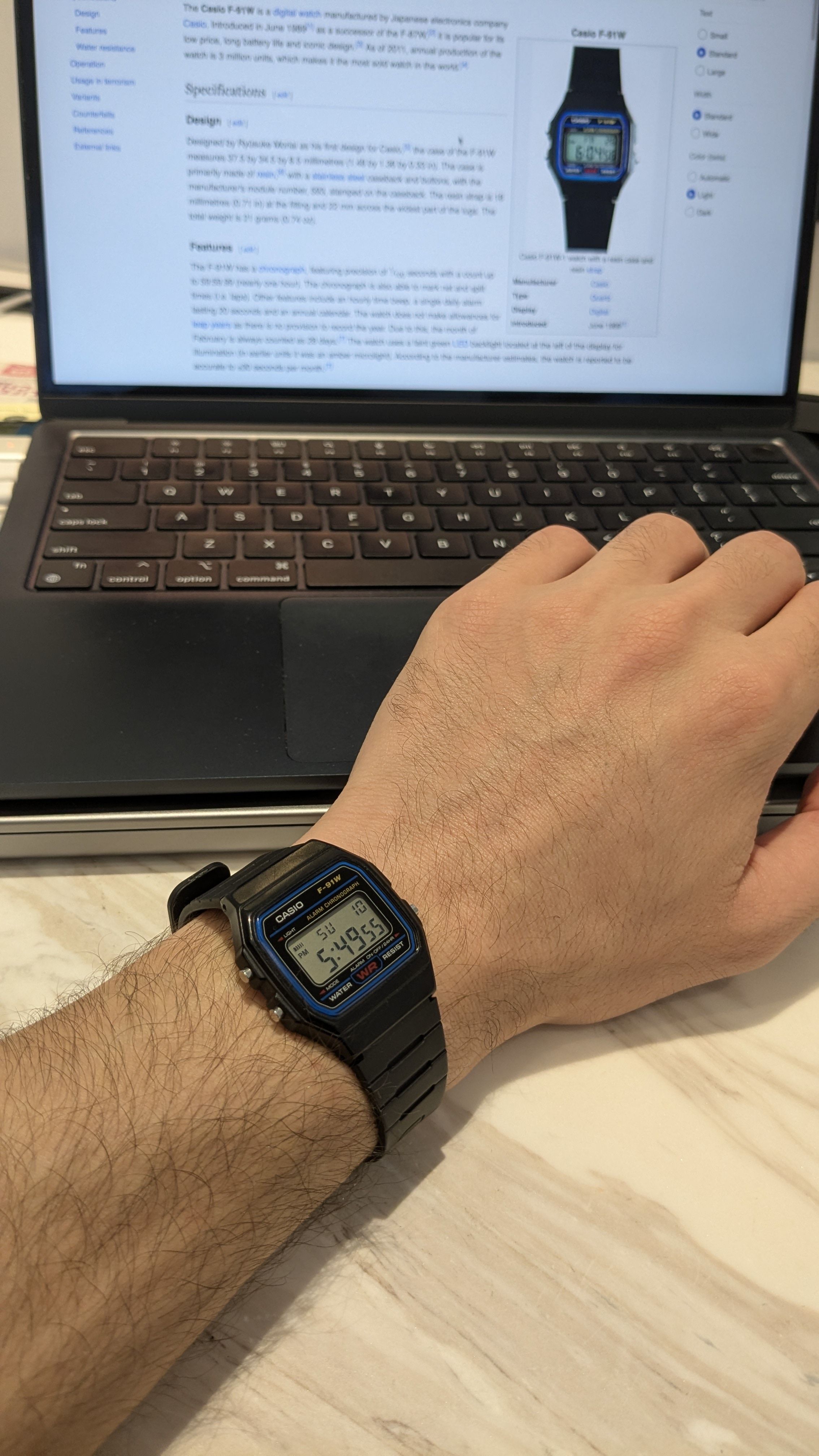
This watch is a philosophy you wear on your wrist. Its greatest feature is its profound lack of features. You forget it's there. It's not jewellery; it's infrastructure. And like all good infrastructure, it has a "bomb-proof" reputation. I'm not just being figurative. According to declassified documents, possession of an F-91W was considered by US military analysts to be a "sign of al-Qaeda," as its reliable timer was a favourite of bomb-makers in Afghanistan. For a time, wearing this $5 watch could earn you a one-way ticket to Guantanamo Bay. It's a watch with a rap sheet. How could you not love it?
My other friend Jason and I talk about watches a lot, but we speak different languages. He's the only friend I have who truly loves them, but our appreciations diverge. He, a man with impeccable taste and a collection of what can only be described as wearable art, speaks of movements, resale value, and aspirational pieces he wistfully admits he could afford if he knew for sure he wasn't going to have kids. I get it, I truly do. But when he suggests I "upgrade" to a metal-strapped cousin of the F-91W, I tell him no. The magic is in the plastic. A metal watch has weight; you feel it. This is more like a bracelet. You forget it's even there.
For me, at this stage of my life, the F91W is the upgrade. It's an upgrade in simplicity, in frugality, in blissful ignorance of how many emails I've just received.
But even the most resilient icon has a weakness. For the F91W, it's always the strap. My last one suffered the same fate. For weeks, I'd been sending Jason grim photo updates of the deepening resin cracks, like a doctor monitoring a terminal patient. Then one day, it finally gave up the ghost. I wasn't just going to throw the watch away; that would be a betrayal. This wasn't waste; this was a challenge.
The Optimizer in me immediately saw a problem that needed fixing. I scoured Amazon, eBay and Temu, but the knock-off straps weren't right - the buckle was a jarring silver instead of black, the texture was off. I had bought one of those before and didn't like it. A NATO strap felt like putting a racing spoiler on a Toyota Camry. It just didn't fit. I'd almost given up and resigned myself to buying a whole new watch.
Then, while wandering through a Dubai mall on a different mission, I stumbled upon a tiny watch repair stall. To my surprise, the guy actually had loose straps. Hundreds of them. My first problem: I had no idea what size I needed. Out came the phone, a quick search for "F91W strap size," and my answer appeared: 18 millimeters. Armed with data, I approached the counter.
The man behind it had headphones in, lost in his own world. Through a combination of broken English and vigorous pointing, our negotiation began. "Eighteen millimeter, plastic," I said. He nodded, then proceeded to pull out a tray of supple leather straps.
"No, no," I insisted, a little louder this time. "Plastic. Cheap plastic." He just smiled and pulled out another tray of leather. And another. Realizing words were failing us, I switched to the universal language of JPEGs and showed him a picture of the watch on my phone.
"Ah!" A spark of recognition. I was already starting to turn away, defeated, but he put up a hand - a silent "wait here" - and motioned for me to come back. He ducked under his counter and emerged, triumphant, holding a brand-new F91W, complete with a little cotton string and a Casio tag.
He handed it over. It felt immediately wrong in my hand. The font was off, the colours too bright. But this was my chance. I'd always wanted to try the legendary counterfeit test, the one where you hold down the right-hand button for three seconds until the screen displays "CASIO." I held the button. The screen flickered and, sure enough, the magic word appeared. The internet was wrong. My own senses, however, were not. Despite passing the test, I could tell this thing was a piece of junk.
I handed it back, said a simple, "No, thank you," and walked off, principles intact.
I was halfway back to my car when my Optimizer brain seized control from my purist heart. The penny dropped with the force of a dropped anvil. The moral objection wasn't about supporting counterfeiters; it was about not wanting to buy garbage. But I wasn't buying the garbage watch. I was buying the exact strap I needed, a part I couldn't find anywhere else, for the price of two coffees.
I turned back. He was with another customer. I waited, then said, "Sure, I'll take it. Twenty dirhams."
I expected him to hand over the whole watch, a little trophy for my troubles. Nope. With the practiced ease of a surgeon, he popped the straps off the face and handed me just the two pieces of plastic. A deal's a deal.
The next day, between work calls, the transplant surgery began. I, a man without a proper watch tool, grabbed the first pointy object I could find: a sewing needle. I lined it up with the pin, took a deep breath, and pushed. The pin didn't budge. I pushed harder, banging it against my desk. The needle, with the structural integrity of a wet noodle, bent into a perfect 90-degree angle before snapping, firing its tiny, vengeful tip into an unknown corner of my apartment and leaving a constellation of tiny, pockmarked memorials on my marble desk.
Plan B. I rummaged through my cycling gear and found my Dynaplug - specifically, the sharp reaming tool designed to clear debris out of a tyre. It was the definition of using a sledgehammer to crack a nut, but it was effective. With a determined push, the pin was out.
I attached the new-old strap. It looked the part, but it felt stubborn, rigid, unlike the soft, pliable resin of the original. It had the uncooperative posture of a teenager being forced to a family dinner. But it works.
For $5 and a broken needle, my faithful watch is back on my wrist. It's a hybrid now, part authentic, part imposter, a testament to reuse and repair. And it reminds me that in a world begging you to upgrade, sometimes the most satisfying thing you can do is just find a way to keep the real thing going.
P.S. - September 15, 2025: The universe has a sense of humour. Within a month of the transplant, the little prong on the buckle - the tiny metal pin that slots into the hole to hold the strap closed - snapped clean off. The strap was fine. The watch was fine. But without that pin, the whole thing was just an expensive bracelet that told the time while sliding off my wrist.
The cruel irony is that the original buckle, with its perfectly intact prong, was already in landfill. I'd thrown it out with the old cracked strap. Had I kept just that one small U-shaped clasp, I could have done another transplant and kept the saga going. But I didn't. Sometimes the Optimizer fails to optimise.
So I did the thing I'd been resisting all along. I bought a brand new, genuine F91W on Amazon for 65 AED (~$17) shipping included. $17 for a fresh start and a strap that actually stays on my wrist. Maybe there's a lesson here about knowing when to stop tinkering and just let things be new. Or maybe the lesson is to never throw away spare parts. I'm going with the second one.